

Italy’s Spring/Summer Weather: A Quick Guide
Planning a trip to Italy in 2026? Expect variety when it comes to the weather. Spring, encompassing April and May, is generally mild, but can be unpredictable. In the north, like Milan or Venice, temperatures average between 11°C and 18°C (52°F to 64°F). Central Italy, including Rome and Florence, enjoys warmer days, typically ranging from 15°C to 23°C (59°F to 73°F). Southern Italy and the islands – Sicily and Sardinia – can reach 20°C to 27°C (68°F to 81°F) during these months.
Summer, from June to August, brings heat, especially in the south. Temperatures in Rome and Florence regularly climb above 30°C (86°F), and can easily exceed 35°C (95°F) during heat waves. Sicily and Sardinia can experience even more intense heat, often reaching 38°C (100°F) or higher. Be prepared for humidity, particularly along the coastlines. Rain is less frequent in the summer, but afternoon thunderstorms are always a possibility, especially in mountainous regions. Don't assume dry weather means you can leave a light jacket behind.
Italy is a long country, so expect varied weather. The Dolomites will have different conditions than Puglia. Packing for various possibilities is sensible. Checking a detailed forecast a week before departure is recommended, but be prepared for unexpected showers or temperature drops.
Clothing: Layers are Your Friend
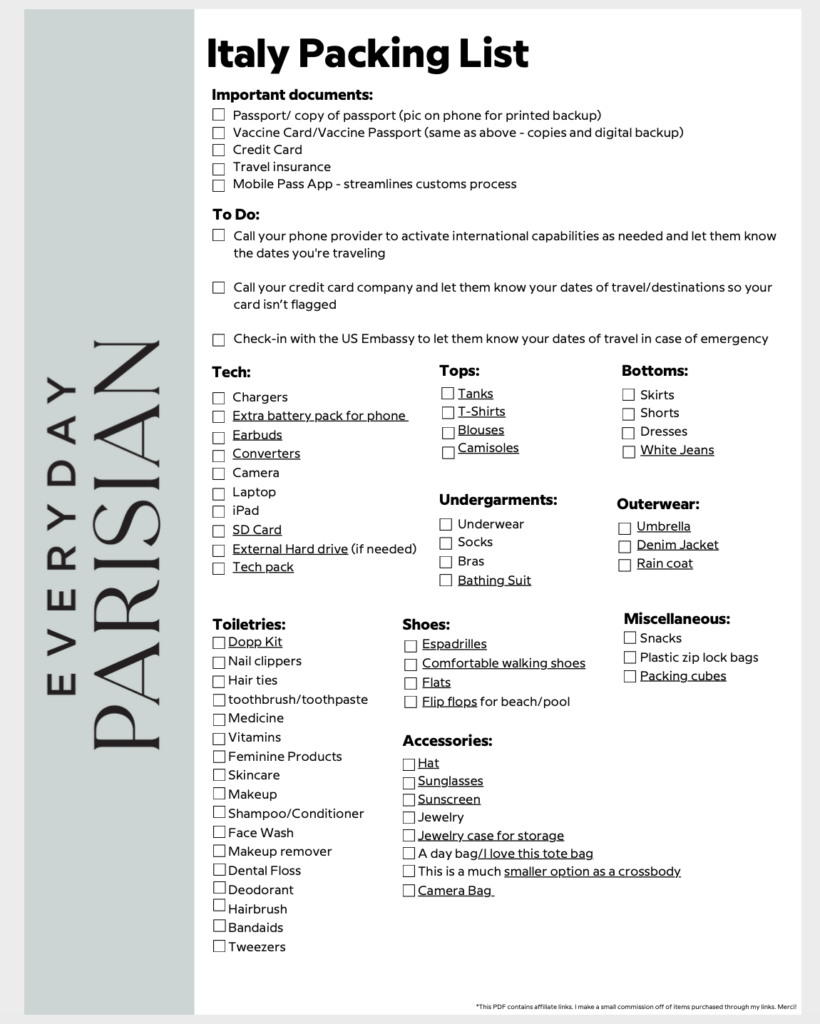
Versatility is key for a successful packing list for Italy. Focus on items you can mix and match rather than packing an outfit for every occasion. For tops, pack a combination of t-shirts, tank tops, and a few nicer blouses or shirts. Linen and cotton are excellent choices, as they are breathable and comfortable in warm weather. A lightweight, long-sleeved shirt can provide sun protection and be useful for cooler evenings or visiting religious sites.
Bottoms should include comfortable walking shorts, capri pants, and at least one pair of long pants. Jeans are fine, but can be hot in the summer heat. For women, a versatile skirt or two is a good addition. Dresses are also a great option – a simple sundress can be dressed up with accessories for dinner. Italians tend to dress a bit more smartly than you might expect, even on vacation, so having a few options for nicer evenings is a good idea. Think about pieces that can transition from daytime sightseeing to a casual dinner.
Outerwear is often overlooked but important. A light sweater or cardigan is essential for cooler evenings or air-conditioned spaces. A lightweight jacket or windbreaker can be useful for spring showers or breezy coastal areas. A pashmina or scarf can serve as a wrap on cool evenings, a sun shield, or a makeshift blanket on the plane.
Accessories can elevate any outfit. A stylish belt, a statement necklace, or a colorful scarf can make a difference. Comfortable shoes are non-negotiable, but a pair of dressier sandals or shoes can also be useful for evenings out. Pack underwear and socks appropriate for the weather and your activity level.
Footwear: Comfort and Coverage
Prioritize comfort when choosing shoes for Italy. You’ll be doing a lot of walking, often on cobblestone streets. Broken-in walking shoes are essential. Avoid bringing new shoes, as blisters can ruin your trip. Look for shoes with good support and cushioning. Supportive sneakers are recommended for long days of sightseeing.
Sandals are a good option for warmer weather, but choose wisely. Avoid flimsy flip-flops, which offer little support and aren't always appropriate for entering churches. Look for sandals with good arch support and adjustable straps. A pair of dressier sandals or shoes can be useful for evenings out. Many churches require shoulders and knees to be covered, so avoid very revealing footwear.
Tourists have been denied entry to churches for wearing inappropriate shoes, such as flip-flops. Have a pair of shoes that meet dress code requirements readily available. Consider packing a lightweight pair of foldable flats or ballet shoes that can easily be tucked into your bag.
Essentials for Religious Sites
Italy is home to countless beautiful churches, and many require modest dress. The Vatican is particularly strict. Men must wear long pants – shorts are not permitted. Women must wear pants or a skirt that covers the knees, and their shoulders must be covered. Sleeveless tops and low-cut blouses are not allowed. Security guards rigorously enforce these rules.
A lightweight scarf or shawl is an invaluable addition to your packing list. It can be easily draped over your shoulders to provide coverage when entering a church. A large scarf can also serve as a blanket on the plane or a wrap on cool evenings. A long skirt or pair of pants that can be easily paired with different tops is recommended. Being prepared is better than risking being turned away from a historic site.
While rules are generally more relaxed at smaller churches, it's best to err on the side of caution. Assume a modest dress code for all churches in Italy.
- Long pants or skirts (covering the knees)
- Sleeved shirts (covering the shoulders)
- Lightweight scarf or shawl
Sun Protection: Seriously Important
The Italian sun can be intense, especially during summer. Protect your skin by packing a high-SPF sunscreen (at least SPF 30) and applying it liberally, even on cloudy days. Reapply every two hours, or more frequently if swimming or sweating. Don't forget often-missed areas like your ears, neck, and the tops of your feet.
A wide-brimmed hat will provide shade for your face and neck. Sunglasses are essential to protect your eyes from glare. The UV index in Italy can be very high during summer, so take precautions. Carry a small, travel-sized sunscreen in your bag for easy reapplication throughout the day.
Consider wearing lightweight, long-sleeved clothing for additional sun protection. Many brands offer clothing with built-in UPF protection. The sun's rays are strongest between 10 am and 4 pm, so seek shade during those hours.
Gadgets and Tech: Staying Connected
Pack essential tech items. A phone charger is a must, as is a universal adapter – Italy uses Type C and L plugs. A portable power bank can be useful for keeping devices charged on the go. A good camera is essential for capturing memories. Back up your photos to a cloud service or external hard drive.
Consider purchasing a local SIM card to avoid roaming charges. Several providers offer affordable data plans. Check with your mobile carrier before you travel for options. Wi-Fi is widely available in hotels, cafes, and restaurants, but it's not always reliable. Download offline maps before your trip, just in case.
Bring a universal adapter, even if your hotel provides one. Having a spare can be useful for charging multiple devices at once.
Health and First Aid: Be Prepared
Pack any necessary medications, along with a copy of your prescription. Motion sickness remedies can be helpful if you're prone to car sickness, as some roads in Italy are winding. Hand sanitizer is useful for keeping your hands clean on the go. A basic first-aid kit with band-aids, pain relievers, and antiseptic wipes is a good addition.
Travel insurance is highly recommended. It can protect you against unexpected medical expenses, lost luggage, and trip cancellations. Check with your insurance provider to see what's covered. Purchase travel insurance before any international trip.
Pack a small first-aid kit with essentials, even if you don’t anticipate needing it. Being prepared is better than searching for a pharmacy when you're feeling unwell.
Baggage Rules and What to Leave Behind
Airline baggage restrictions vary, so check with your airline before you travel for the most up-to-date information. Most airlines have limits on both the weight and size of checked and carry-on baggage. Weigh your bags before you leave for the airport to avoid overweight baggage fees. Pack a change of clothes in your carry-on bag, in case your checked luggage is delayed.
Avoid bringing valuables or expensive jewelry. Italy is a relatively safe country, but pickpocketing can occur, especially in crowded tourist areas. Anything you can’t afford to lose should be left at home. Sentimental items are also best left behind – losing a cherished possession while traveling can be devastating.
I always travel with a carry-on only if possible, to avoid the risk of lost luggage and save time at the airport. It forces me to pack more efficiently and only bring what I truly need. Check your airline’s website for the most current baggage allowance details before you start packing.
Carry-on vs. Checked Baggage for Italy Travel
| Factor | Carry-on | Checked Bag |
|---|---|---|
| Cost | Generally Lower | Potential for extra fees |
| Convenience | Faster airport experience | Slower; potential for delays |
| Risk of Loss/Damage | Lower | Higher |
| Airline Restrictions | More stringent size/weight limits | More lenient, but still subject to weight limits |
| Accessibility | Items readily available during travel | Items unavailable until arrival |
| Item Variety | Limited to essentials | Greater capacity for diverse clothing/items |
| Security | Direct control of belongings | Reliance on airline handling |
| Peace of Mind | Better for valuable/essential items | Suitable for less critical belongings |
Qualitative comparison based on the article research brief. Confirm current product details in the official docs before making implementation choices.
No comments yet. Be the first to share your thoughts!